
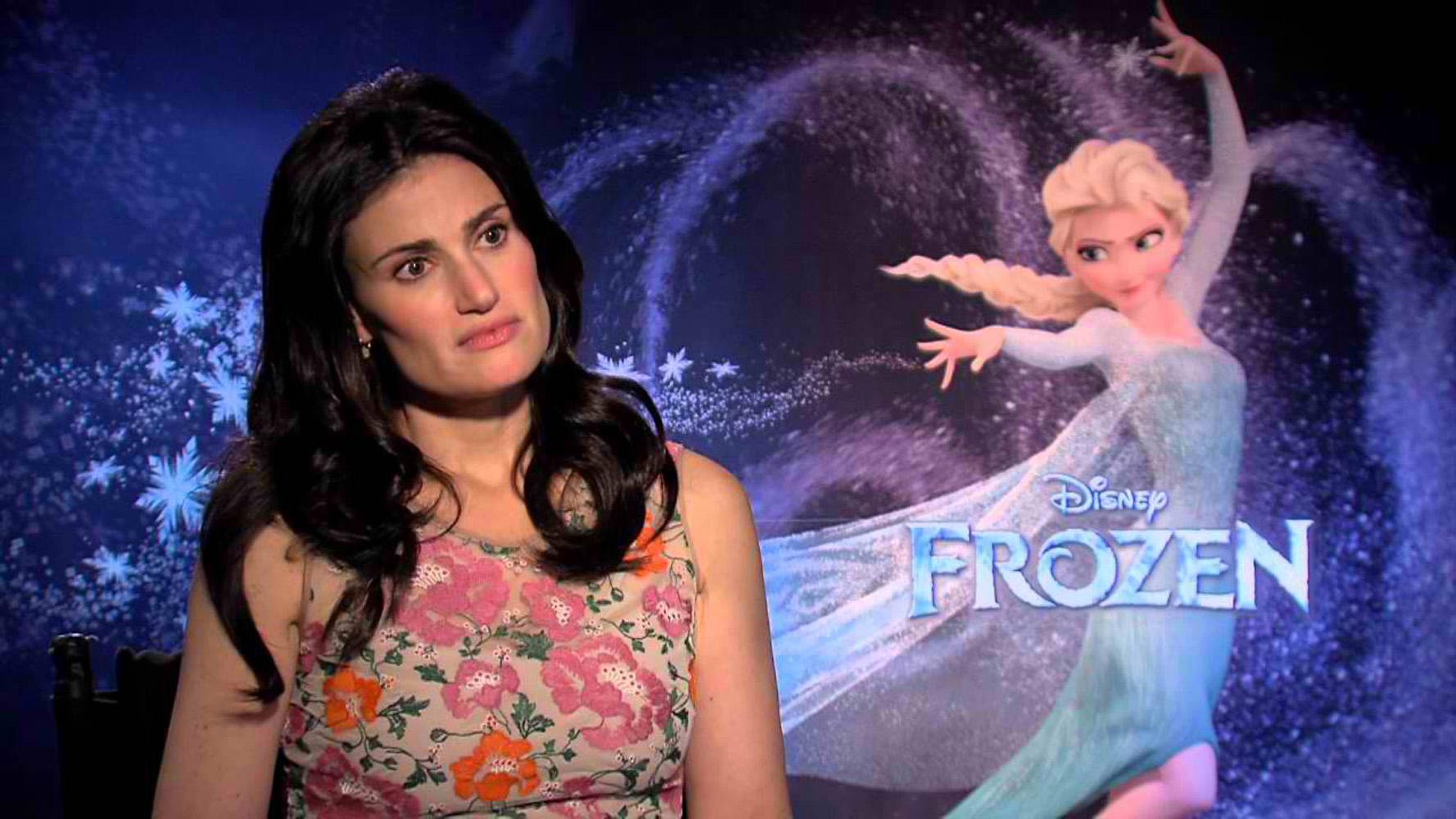
Dearests, I was among the Broadway Faithful who let out a collective primal scream when Mr. John Travolta (whom my own dear father dubbed “John Revolting” in the 1980’s, just as a joke to tweak my mother, who had a major crush on the guy) MANGLED the name of Idina Menzel on the Oscars telecast last weekend. Mis Menzel, many of you know, provided the voice of Elsa in the movie “Frozen” and is the pipes behind the hit song, “Let It Go.” She is a DIVA. And her name is not Adele Dazeem.
“WHO THE HELL IS ADELE DAZEEM?” exploded Twitter, and henceforth skewered Mr. Travolta for his gaffe.
Richly deserved. As the popular meme goes, he had one job to do. ONE job. ONE moment. ONE person to introduce. Unlike other presenters who often have a long list of challenging, unfamiliar names to pronounce in sequence, John Travolta had a tiny bit of lead-in patter and then one name to share with the billion viewers all over the globe. IDINA MENZEL.
Here is what it communicates when someone bungles a name badly and (a) shows no signs of knowing that he has done so and (b) makes no immediate effort to correct himself: it says, “I do not care about you. I have never heard of you, you are not important, and you were not worth the thirty seconds it would have taken me to learn how to pronounce your name correctly and to therefore honor you and your ancestors by doing so.”
Have you heard that expression to “call someone out of their name?” John Travolta LITERALLY called Idina Menzel out of her name, and no excuse suffices. Perhaps John T. does have dyslexia, as some have suggested. Still no excuse. Our job as public leaders is to know and accommodate such things about ourselves before getting in front of a billion people. John Travolta has had a long career memorizing dialogue and lyrics, and he is clearly not in the early stages of dementia.
He just didn’t care enough to go over and over the one name he had to pronounce.
So how does this translate to our work, my lovely and dear ones? It reminds us that we should take the time to ask, and to ask, and to ask again the correct names and pronunciations of people’s names when we shall have the honor of uttering them in an important setting. It means that we should get the names straight when doing a memorial service so that we do not mix up the name of the first wife with the girlfriend or the granddaughter. It means that we consider it our sacred obligation never to stand at graveside and realize, with horror, that we have never set eyes on the middle name of the deceased before this moment and have no idea how to accurately pronounce it.
It means, as in all things ministerial, serious aforethought to everything we do, even though it may seem to be routine, and even though we feel that we can skip serious preparation because we have done this a thousand times before.
To mispronounce someone’s name creates a cringe experience for them, and that is never okay.
I am still beating myself up for doing a christening recently where I accidentally referred to the baby’s father as “Roger,” the role he played in “Rent” when he met the baby’s mother. We all had a good laugh, and it was fairly okay because Ken knows that I know his name is Ken, and I had already correctly spoken his name in the ceremony. Still, because I don’t know Ken personally, my slip was evidence that I think of him in my mind as “Roger,” and that’s not okay. Had I spent more time in prayer and preparation for the occasion, I would have had the name Ken in my heart and mind so thoroughly that Roger wouldn’t have had a chance to slip in there. I have learned my lesson! Next time, make sure to go over and over and over the parents and godparents’ names with as much care and intention as I do the baby’s name, and the service itself.
Not only are we responsible for pronouncing the names of those in our pastoral care correctly and confidently (without constant reliance on a script, as though one has no true connection to the people), we should make it our business to train our lay leaders and church staff likewise in the pronunciation of all names, both current and historical/Biblical. How awful to sit on the chancel and hear someone praise a loyal volunteer but mangle her name? Or to feel one’s spine stiffen with horror when the Good Friday reader pronounces Pontius Pilate’s name as “Pilates,” as in the exercise technique?
As you can tell, PeaceBang is a bit of a stone cold Fury when it comes to this subject. This is no doubt due to the influence of her late father, the frequently furious but wonderful Carl Davis Weinstein, who spent his life correcting the pronunciation of his last name (which is WINE-STINE). My daddy always told me, “Baby, the first time someone mispronounces your name, correct them. If they do it a second time, you may or may not choose to give them the benefit of the doubt, but correct them again. If they do it again after that, write them off as an idiot and a schmuck. Someone who can’t be bothered to learn how to pronounce your name correctly doesn’t really respect you, or they just don’t know how to listen. Both things are bad.”
Names are sacred. God knows they are. Take them seriously!
Kiss of peace, PB (Miss Weinstein)
There was a frequent customer of mine in the bookstore where I worked years ago, who constantly called me by the name of my predecessor and by the name of the woman who planned special events. She finally got it when I politely corrected her the time we ran into each other outside of work when and she admitted she couldn’t remember my name. After I told her what my name was (and that I wasn’t Catherine or Elizabeth), she never forgot my name from that moment on.
Part of my current job involves interviewing new sales associates, and I make a point of writing down *phonetically* how someone’s first and last name should be pronounced and make sure I (and anyone else doing the interview) know how to say their name.
Ditto for preachers and lectors who don’t learn how to pronounce biblical names. (You don’t need to know how to pronounce those OLD names. It’s all about the NEW testament and Jeee-zus! [Yes, ma’am! – PB]
Gah. I live with this. All. The. Time.
My family name is pretty rare, and the correct pronunciation is not obvious from the spelling. My first name, while traditionally spelled, is not super common either. (The combination is a near-unique identifier, which is why I limit where I put it online. Approximations of privacy that I wouldn’t need to think about if I were named “Jen Smith” or similar.)
A-a-a-and the spelling of my family name very close to a given name that was popular a few years before I was born (there were two at my last job, for instance.) So I get addressed by that name at least once a week.
It’s always nice when someone gets it right.
How this resonates with me!
I have been at several public events in the past month (banquets, awards ceremonies, class presentations) where the person who introduced me (always someone I met, sometimes someone I knew fairly well) has screwed up my last name beyond recognition or refused to say it at all. It hurts me each time, and I’ve even “taught” my last name to some of these people. I just can’t quite explain it, except to say that it seems vaguely racist and lazy.
We live in a diverse world, and we need to be able to say last names beyond Smith, Adams and Jones. [Amen, and you nailed it. First is the laziness of not reviewing the text of what we’ll be saying, and not taking responsibility for it. The second laziness is more pernicious and communicates that one doesn’t have to learn to pronounce “those funny words.” It is racist. Thank you for naming that. My father’s ire came from the sneering anti-Semitism he got when he dared correct those who were offended to have to introduce or respond to or reserve a table for a Weinstein. – PB]
Yeah, my last name was impossible to spell OR pronounce (Toepfer. T-as-in-Thomas, O E, P-as-in-Peter, F-as-in-Frank, E R. Pronounced TEP-fur), so I didn’t get bent out of shape about it when people got it wrong. However, I certainly took it as a sign of care/generosity/attention when someone DID get the name right.
That being said, I definitely took advantage of getting married to change to a name that’s far easier to deal with. I can put up with the Peter Pan references.
how else would Weinstein be pronounced? it seems so easy to me!
I appreciate Stephanie’s naming this as sometimes racist. I think that’s important to acknowledge. And sometimes it’s not so much racist as zenophobic. I have been married twice, both times to men whose surnames are Western European and — come on, people! — not that difficult to pronounce. But they are multi-syllabic, and they have lotsa letters in them. OMG! A long name! Panic sets in! All it would take is a polite inquiry and PAYING ATTENTION to the answer, but I cannot tell you how many zillions of times these names have been mispronounced. Thanks for lifting this up, PB.
A personal worst: interring the ashes of a woman’s father in the basement crypt of a church I served, I said he would be joining his wife Dorothy. Her name was actually Doris. And she wasn’t in the niche. (The niche was above my head and I couldn’t see in, I just thought I remembered the daughter saying she was in there. #ministersuperfail.)
Thank you for addressing this! As someone who’s spent her life being called “Susan” or “Suzanne” no matter now many times I introduce myself as Susannah and correct the mis-pronouncers, I am grateful to see you call out this “I’ll call you what I feel like calling you because your name needs to make me comfortable” for the lazy, unkind, disrespectful practice is. Miss Weinstein, you inspire all of us ministry students to know better, and do better. Thank you.
On a related note, what steams me is sports commentators mispronouncing foreign names, particularly Asian names. Olympics commentators are the worst offenders, which is just beyond the pale. They can rattle off multi-syllabic European names, but the three short syllables of a Chinese name stymies them. There are simple rules for this! No flat a sound as in “cat”. It’s “ah.” And the last name comes first!
Drives me crazy and it seems lazy and yes, racist. (I grew up in Asia)
And then there are all those who diminish one by adding “y” or “i.e.” to one’s name. When men do it to me, I always feel they are doing it do make me less equal or less adult. Friends can do it affectionately sometimes and that’s fine or one’s mother but no one else.
Yes! Yes! Yes! I once had a young man sitting in my office in utter despair because when he was baptized (which we do for those who have reached “the age of decision”) the pastor had used his brother’s name. And then had brushed it off when he had approached him about it afterwards. After 10 years he was alienated from the church and from his own spiritual life because that “innocent” mistake had not been righted. [Wow. Can you imagine being told that it doesn’t matter that you were baptized with the wrong name!!!?!?!? – PB]
Amen! Caring about someone’s name goes such a long way toward demonstrating care for that person. I would so much rather someone ask how to pronounce my last name than consistently get it wrong…
This was really driven home for me a few weeks ago when I was sitting at our campus ministry’s table at the activities fair. We had gotten in a conversation with two Chinese exchange students, and they’d written their names on our email signup but not said them aloud. When we were saying our goodbyes I looked down at the sheet to greet them by name, and when I said “Kyungah” more or less correctly, I felt such a sense of trust and connection from her. And that has nothing to do with speaking Chinese (I don’t), for me it’s just about *listening* to people who speak Chinese. It’s about respect.
When I did CPE, my supervisor was adamant about instructing us to make sure we ask about name pronounciation. It’s true – a person’s name is part of their identity, and when exchanging introductions, it shows respect to get the name right. I have a name that gets butchered all the time and I have a hard time with people who’ve known me for years, yet never make an effort to get it right, or call me “Doris” (first name) because it’s easier. I tell them Doris was my grandmother. Unfortunately, I’ve run across one or two people who won’t try with names foreign to them because of their politics/anti-immigrant/anti-diversity/you get what I’m saying stuff. That’s a whole ‘nother problem.
As someone who has, my whole life, been called ‘Julie’ instead of Julia, I can relate! It took almost everything I had to correct a former supervisor of mine, and to correct parishioners! I’m working on my pastoral authority, and getting better all the time. I’ve learned to correct people the first time.
What is really funny is that our church has two administrative assistants, named Julie and Juliet, while I’m associate pastor Julia, so when people call and just start talking to whoever answered the phone it gets funny. And when they have to leave messages on our voicemails it gets pretty crazy! Names are important, be mindful when meeting new people, and give them the respect to learn it correctly!
Good advice. But I have also realized I can get anxious about remembering names… So anxious that I don’t use people’s names even when I am 99 percent sure I know them. So I need to take this advice to heart but also relax and realize it is not the end of the world if I make a mistake.
My last name is spelled right by about half the people and pronounced right by the other half. For that reason, I’m pretty careful about names. I work at a university, and I always wonder why our student information system has a field for “preferred name” (for example, Rob vs. Robert vs. Bob), but not for pronounciation. My doctor’s office could use that as well.