
It’s always tough to go from an ecclesiastical engagement to a social one, isn’t it? And what’s a girl to WEAR?
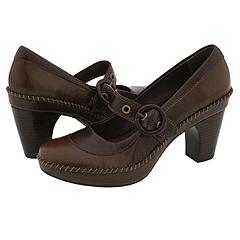
This Sunday I will be participating in an installation (wearing vestments to the service, but there’s the reception to dress for, too) and then meeting friends for a casual dinner. It would be so tempting to wear a cute dress with a long, granny sweater, boots and big earrings and do the Boho Look, but that just wouldn’t be appropriate for the historic congregation. I feel that a formal occasion in the church calls for structured clothing on the clergy. Therefore, I will be wearing a black suit, these shoes in blackbrown-belladonna.jpg, and try to add some “interest” factor with a neat belt and scarf. I’ll have to be overdressed for dinner but there are benefits: that belt and slightly snug blazer will probably keep me from chowing down too enthusiastically!
Pigeons, hear me on this: no minister should wear corduroy anything to an installation. It’s too informal. We have so few truly special occasions left in this jeans-and-Crocs world, the clergy should be impeccable at these events. It’s a visual way of connecting with the past and honoring the present.
Furthermore, my fine feathered friends, our conduct at installations and ordinations should be as elegant as our dress. It pains PeaceBang’s heart and makes her blood pressure rise when ministers get into the pulpit at an ordination and make jokey, social-clubby work of the Charge to the Minister, the Right Hand of Fellowship or any of the other elements. This is wildly inappropriate and PeaceBang ardently wishes she never felt the need to say anything about it, but she finally must. An ordination or installation is not a party, it is a religious ceremony. An installation is not a clergy hazing ritual, it is a sacred rite which establishes bonds between congregation and their chosen minister (I speak from a congregational polity perspective, of course). It is one thing to use warm humor and a personal touch in our moments with the ordinand or new minister; it is another thing altogether to chortle and fumble our way through some aspect of the liturgy that we have not thoroughly prepared on the theological, emotional and purely technical level. The former is delightfully human, the latter is inexcusably sloppy and disgraceful.
If we are asked to participate in an ordinaton or an installation, it is our responsibility to know where our piece fits in the liturgy, to meet with the liturgist (or at least speak with him/her) about our part, and to think through not only our words but our “staging,” if there is any. We should arrive early enough to robe and to receive our instructions regarding how and when to ascend the pulpit, and when to leave. Are we introducing a hymn? Should we remain up at the pulpit while another colleague gives a prayer or reading, and exit with him/her for symmetry’s sake? We must think not only of our piece, but of the transitions in and out of it.
There’s an awful lot of showbiz in these services, and as it is the participants’ responsibility to learn our part, so is it the responsibility of the ordinand/installee to stay in close touch with the presiders and to provide them with all the information they need. There should be a marshall chosen and trained in advance to “run the show,” if you will, so that the ordinand or “installee” is not troubled by these details on this big day. A water pitcher and glasses, tissues, cough drops and sufficient copies of the Order of Worship will all be appreciated in the robing room, as will a full-length mirror and un-messy, un-sugary snacks for pastors on the run who had no time for lunch. If we wonder why so few of our colleagues attend ordinations and installations, PeaceBang would tend to guess that low blood sugar and late-Sunday exhaustion has a lot to do with it. Set out some coffee and little sammies for the preacher boys and girls and we may see our district attendance rising at these events.
If they are traveling any considerable distance, a sit-down meal should be provided afterward for major participants (whom we may assume are especially dear to the ordinand’s heart and therefore a delightful prospect as dinner guests): they should not be expected to fill their bellies while on their feet during the busy din of a reception. This meal should be planned with the Ordination/Installation Committee and can be as simple or as fancy as the church budget allows. It should not be omitted for any reason, however, as it is most inhospitable to import colleagues from a distance and then fail to feed them before they get back on the road home. What have we come to that we should expect either busy colleagues or eminent retirees to travel to our church on our behalf, deliver carefully prepared words and prayers, stand on their feet for an hour “working the crowd,” and then climb back into the car or plane exhausted and unfed? I’m sorry to say it so bluntly, newbies, but a generation that considers gracious hospitality optional is a sorely deficient generation of the Church.
Hear ye! Preachers for the event should receive a gift in the mail within a month of preaching your service: they have, after all, taken extraordinary pains to craft a special sermon for your special event and very possibly their second of the day. It is an enormous honor to be asked to preach at your ordination or installation, but also a burdensome responsibility. Do not fail to recognize, and to appreciate, this. PeaceBang has preached one ordination sermon in her life that took her no less than 15 hours to craft to her satisfaction( and during her vacation, no less)! She doubts that this gets much easier with time and experience. Other participants should receive a written thank-you note within a few months.
Although we are in an era of modernizing the church and its programs, installations and ordinations are occasions requiring the utmost decorum and attention to detail. They are teaching moments for the Church and shining examples of our polity in action. Above all, congregations themselves should be educated well in advance of the installation or ordination on the history and meaning of these occasions so that they are not, as PeaceBang has too often seen in the Free Church, sitting in the pews under the impression that they are passive, fond observers of this ritual, but understand their centrality to the proceedings.
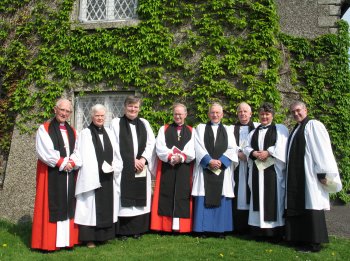
(Random photo: I have no idea who all these Piskies are but they look nice for this event.)
AMEN SISTERFRIEND!!!!
I especially like the tips about serving meals and healthy snacks at these important events. I have been very disappointed at the lack of clergy presence at most of these events however let us remember the old adage if you serve food…they will come.
Amen and amen! What god guurrll said… plus a reiteration of how important it is to think through the blocking. I gave the Charge to the Minister at a dear friend’s installation in a modern-ish church where the “chancel” was a platform with no sides and no back, just the pulpit standing on it over to one side. From the pulpit, I beckoned my friend (the installee) to come stand beside me while I gave her the charge, but I had neglected to think this through, and she ended up on the far side of the pulpit, with about 8″ of floor space to stand on. It was difficult for me to concentrate on my deathless prose while worrying that my friend was going to make an ignominious descent into the congregation from her own chancel.
Don’t all y’all in the Free Church traditions have rehearsals before such an event?
I just helped out at the ordination of a friend of mine up in the PNW (Pacific Northwest) this past summer and those of us involved in any way in the ceremony had to show up at the local Episcopal Cathedral for rehearsal, complete with blocking and the whole nine yards. It didn’t last for two hours, though, because it turns out there was the rehearsal and then a nice little lunch prepared by the nice church people. The liturgy was gorgeous and everyone was more relaxed because we already knew where we were headed to sit and stand and speak.
I meant to write “had to show up TWO HOURS AHEAD OF TIME at the local Episcopal Cathedral”… Sorry. Tired after long day.
You know we ‘Piskies are compulsive about liturgy, but honestly, it makes for a much more relaxed service if you rehearse especially the little details. And of course if someone screws up during the event it’s okay, we’re among friends, but it’s nice to know where we’re headed and have some choreography (that’s really what this is) and it doesn’t and didn’t take away in any way from the freshness of the event. It’s the same as having a wedding rehearsal. When you know where you’re headed, you can relax — and really feel the Spirit! Or spirit, depending on your theology ;-).
Small worship services are another story entirely, and I’m all for sitting on the floor in informal prayer and ritual circles, but when you’ve got a big thing going, the rehearsal and blocking business is every bit as important as wearing the proper attire.
The lack of blocking and liturgical preparation at ordinations and installations makes me NUTS. My ordination is likely another 6-9 months away (:sigh:) but I already have a friend assigned to be the Marshal/Worship Coordinator. There will be no “oopsy, am I supposed to announce the hymn, tee hee” at my ordination, thank you very much.
It’s the same problem I have with lay led services in general. Someone has to be driving the bus, even if it’s not a minister. But I suppose that’s another story for another day.
WR
I’m just a lay member who enjoys this blog and the glimpse “inside.” Just want to say that I agree with the dignity and seriousness of purpose of installation (and other) services. And I agree with Caroline Divine that rehearsal frees me up (I help with music sometimes in our services) to truly worship in unity with the congregation. Thank you, PeaceBang, for a timely “sermon!”
Greetings,
I stumbled across your blog while searching for Pulpit Etiquette.
I appreciate your insight.
The fellowship / denomination with which I am a part desires constant improvement in that area.
We have the hospitality thing down to a science, but because we are of the charismatic sort, we at times neglect order (although we claim we don’t).
Thank You,
Justin Cohen
[You’re very welcome, Justin! Thanks for dropping by, and blessings on your ministry – PB]
Philadelphia [One of my favorite underrated American cities!]
The Bishop in the centre of the photo is Richard Clarke, Bishop of Meath and Kildare, in the Church of Ireland. I don’t recognise anyone else in the photo.