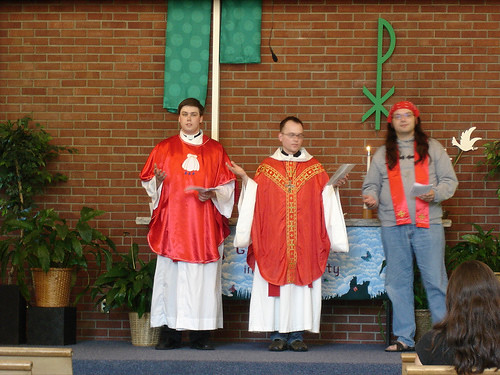
[The conversation continues thusly… I formatted slightly for your ease in reading. Rev. BlueJeans speaks:)
As I was hoping! A Great Coversation!
And yes, of course you can post, sans identifying information.
I think you misunderstand the thrust of my argument. Or perhaps I don’t understand the thrust of yours.
I guess the question is this: what is the baseline of human attire? You point to my dressing-down as hypocrisy. This would indeed be true, if it represents a “disingenuous and inauthentic” departure from what I would otherwise be wearing–a “masquerade,” as you say.
If I would naturally be inclined to dress in suits and ties, but instead wear jeans and sandals, all in an effort to “get with the peeps,” then yes, that would definitely qualify as hypocrisy. But that’s not what’s happening. I would submit that no human, being in a state of nature (a la Locke or Hobbes), would of his or her own free will choose to wear a suit and tie, or a skirt for that matter. And don’t even get me started on high heels. These items of clothing, far from being the thing most of us would choose to wear, are dreaded, uncomfortable, and expensive encumbrances. At best, we wear them because we’re expected to wear them, and because we assume they’ll gain us the approval of others.
So when I wear jeans or shorts, it’s hardly as if I’m stooping my otherwise lofty perch to “get with the peeps.” I’m being as I would like to be in the world–comfortable, and not broke from dropping $400 on a suit.
I ask you this: would it not be less disingenuous (more ingenuous? more genuine? how does that work?) for me to wriggle into a suit and tie on Sundays, simply to satisfy the expectations of the upper-middle-class folks that pay my bills? I can wear what I’d otherwise wear, or I can move into an entirely foreign class of clothing (ties: nooses for men!) based solely on the proposition that it will set others at ease. How is that not disingenuous!?
I don’t propose that we all dress as coal miners or auto mechanics, in an attempt to imitate the dress of the working poor. I simply propose that we don’t all wear, minimally, $100 worth of clothing to church. Why should people who have a desire to come to church be forced to climb over an obstacle like that? Why couldn’t they wear whatever they want? What could clothing POSSIBLY have to do with God, church, and community?
Clothing functions as a social marker…it sets us apart from each other, illuminates differences in class and status, and reminds people of their sitz im leben. I don’t see it as all necessary in the practice of religion. In fact, I see it as fairly inimical to the practice of Christianity.If I could wave a magic wand, I’d institute mandatory casual dress at every church in the country. Luckily for the church ladies, I can’t.
It’s interesting that you bring up family history as it informs our fashion concepts. I do in fact have a great deal of familiarity with poverty; I am the child of Appalachian farmers many generations back, and my mother didn’t have indoor plumbing until she went to college. As a kid, we didn’t have two nickels to rub together, so perhaps my ethics of clothing has been influenced as much experience as by the Marxist-liberation critique I encase it in.
I await the next volley….”